

A Brief History of ‘Karen’
This article first appeared in The New York Times.
In 1965, it was the third-most-popular baby name in the United States. In 2018, it was the 635th — and today it’s even less popular. How did Karens fall so far?
Ask a woman named Karen what she used to think of her name and you’ll hear phrases like “generic,” “perfectly serviceable” and “an easy name.”
In 2020, Karen is no longer “an easy name.” Once popular for girls born in the 1960s, it then became a pseudonym for a middle-aged busybody with a blond choppy bob who asks to speak to the manager. Now, the moniker has most recently morphed into a symbol of racism and white privilege.
A “Karen” now roams restaurants and stores, often without a mask during this coronavirus era, spewing venom and calling the authorities to tattle, usually on people of color and often putting them in dangerous situations. And while this archetype had previously been called “Permit Patty” or “BBQ Becky,” “Karen” has stuck.
In fact, many news reports don’t even bother to use a woman’s actual given name. Whitefish Karen (named for her town in Montana) coughed on a couple when they called her out for not wearing a mask inside a grocery store. Kroger Karen, named after the supermarket chain, blocked an African-American mother’s car so the woman couldn’t leave the market’s parking lot. San Francisco Karen called the police on a Filipino man stenciling “Black Lives Matter” on his own property.
And, of course, the Queen of Karens — Amy Cooper, also known as Central Park Karen — threatened and fabricated accusations against a Black man after he politely asked her to put her dog on a leash, as park rules stated.
For some women with the name Karen, these videos have made them outraged, of course, but also, at times, ashamed.
“I remember hearing about names like Becky and thinking, ‘What if this was my name, how would it feel?’” said Karen Scholl, a 47-year-old writer in Columbus, Ohio, with whom I worked at a college newspaper more than 20 years ago. “It’s just so embarrassing, honestly. But I can’t get bent out of shape. I have no control over it. There are people losing their lives every day. If it’s the only thing I have to be upset about in this world, then good for me.”
Karen Chang, a Bay Area resident who works in business management, had shrugged off early memes, but then the Amy Cooper video changed everything for her.
“It was very upsetting, but I would sacrifice my name for the visibility and awareness that incident generated,” said Ms. Chang, who is Asian-American. Indeed, she may do just that. She said she’s considering changing her name to “KC” after she and her fiancé eventually wed. “It has always been a term of endearment.”
Ms. Chang may be able to change her name, but if one San Francisco Board of Supervisors member, Shamann Walton, has his way, a version of “Karen” will be immortalized into city law.
In early July, Mr. Walton introduced the CAREN (Caution Against Racially Exploitative Non-Emergencies) Act (presumably he couldn’t come up with a suitable word that began with K). The bill would change the city’s code to punish people who call 911 and file false, racially biased complaints.
That’s a step too far for Karen Ortiz-Orband, a Boston-area nurse who is of Puerto Rican and Dominican descent. She supports the contents of the proposal, but emailed Mr. Walton’s office urging him to reconsider its title.
“I asked him to be mindful of the fact that there are women named Karen and people aren’t differentiating between the two. And by naming this bill as he has, he’s doing exactly what the metaphorical Karen is doing — creating an opportunity for discrimination,” said Ms. Ortiz-Orband, who is in her late 40s.
And before you think, “that’s so Karen to complain about CAREN,” Ms. Ortiz-Orband asks you to imagine if it were your name: “It’s one thing to make memes,” she said. “It’s another when you start applying it to laws. You’re villainizing a name that people actually have and you’re putting these people at risk. When a woman acts like that name, you should use her correct name.”
Karen Gormandy, a literary agent and arts studio manager in New York City, said she doesn’t take it personally when she hears her name used in these contexts, “because I assign that meme to white people. I’m totally disconnected from it. I’m on the receiving end of this misbehavior.” Ms. Gormandy, 61, said, “I feel as a person of color I don’t need to apologize and explain my name.”
Yet she said people sometimes avoid using her name when speaking to her: “Some people use Becky instead,” she said, laughing.
The Origins of ‘Karen’
But why the name Karen?
Robin Queen, the chairwoman of the linguistics department at University of Michigan, has looked closely at this question and her exploration led her to, of all people, Dane Cook.
His 2005 comedy album contains a riff called “The Friend Nobody Likes”: “There is one person in a group of friends that nobody likes,” Mr. Cook says, using an expletive to emphasize how much they are, in fact, disliked. “They basically keep them there to hate their guts. When that person is not around the rest of your little base camp, your hobby is cutting that person down.” As an “example” of this person, he describes a woman named Karen.
Other antecedents include Amanda Seyfried’s vacant Karen in “Mean Girls,” who racistly spouts to Lindsay Lohan’s Cady: “If you’re from Africa, why are you white?” A parody account on Reddit from late 2017 based on the rants of a spurned husband is also often cited as an early driver, and highlights the sexism of the “Karen” trope.
Karen Grigsby Bates, the senior correspondent for the “Code Switch” podcast on NPR, said Karen’s roots are anchored deep in American folklore. Ms. Bates — who embarked on this research not because of her name, but because the phenomenon was “a convergence of gender, race, class, social upheaval and social media in this great big tornado” — pointed to the term “Miss Ann” from the antebellum and Jim Crow periods.
African-Americans used the term as code “to refer to these unreasonable white women,” Ms. Bates said. She described Miss Ann as “a woman who knew her place in society, was complicit in maintaining it, and who was at the upper end of the hierarchy. Even if she was a nice Miss Ann, she was still upholding this system that said: ‘White womanhood above all else, except white manhood.’”
Researchers also point to the demographic characteristics of the name Karen. According to Social Security data, Karen soared in popularity in the 1960s, peaking as the third-most-popular baby name of 1965, but never had a resurgence. The archetype is meant to evoke a woman of a certain age, but then again Linda, Cynthia or Susan would, too.
That’s where the Karen theories get geekily fascinating. Miriam Eckert, who has a Ph.D. in linguistics and lives in Boulder, Colo., said that the word “Karen” contains what’s known as a “voiceless plosive.”
“That’s the K sound at the beginning of the word,” Ms. Eckert said. “When you say some consonants, like K or a T, there’s a complete blockage of airflow and a sudden release — whereas a name like Cynthia has no stops at all. Karen is kind of a harsh sound that you can really spit out. And that aligns with the kind of person we are thinking of when we talk about a ‘Karen.’”
The Future of ‘Karen’
But will it always? In 2018 — the latest year for which data is available — Karen ranked as the 635th most popular girl’s name, alongside Elaine and Dallas. “Nobody is going to name their kid this now,” Ms. Gormandy said. “It’s just going to disappear and then somebody not knowing the history of any of this might decide it’s a cool name.”
Ms. Queen, the linguistics expert, agreed. “Maybe in 50 years or so it might come back.”
In the meantime, she thinks it could at some point fade from the lexicon. “The meaning gets so broad that it’s going to stop having the same power to make a particular critique,” she said, pointing to examples like “basic,” “hot mess” and “Negative Nancy” that faded from the lexicon.
As a moniker, she said, “I would be surprised to find it around a decade from now.”
A version of this article appears in print on Aug. 2, 2020, Section ST, Page 2 of the New York edition with the headline: Not All of Them Want to Speak to the Manager.


How to Shoot a Sex Scene in a Pandemic: Cue the Mannequins
This article first appeared in The New York Times.
TV shows like “The Bold and the Beautiful,” “Riverdale” and “The L Word: Generation Q” are trying to figure out how to responsibly film physical intimacy in the time of coronavirus.
Of all the weird ways that Covid-19 has affected life in this country, one of the most bizarre is taking place on a soundstage in Los Angeles. That’s where actors on the CBS soap opera “The Bold and the Beautiful” have been shooting intimate scenes with mannequins.
“At first, we took out the love scenes, and the show was falling a little flat because we’re all about romance and family interactions,” said Bradley Bell, the executive producer of the CBS daytime drama. “One of the first ideas we had was to bring in mannequins for the intimate scenes and hospital scenes, and it’s working quite well — we’re shooting it from a great distance or in a way you can’t see the form is inanimate.”
How are the performers reacting to their lifeless co-stars? “We’ve had a lot of strange looks and questions like, Do you really want to do this?” Bell said. “But everyone is game. They are getting their first latex kiss.”
Viewers will judge for themselves how realistic this appears when new episodes of return on July 20. “The Bold and the Beautiful” was one of the first TV series to restart production after the coronavirus caused an industrywide shutdown in mid-March. Since then most TV creators have been meeting with their staffs in “Zoom Rooms,” penning plotlines and episodes, not knowing whether — and when — they’ll be able to safely capture them on camera.
Covid-19 has been particularly vexing for the writers of TV’s sexiest and most romantic series as they try to figure out how to portray physical intimacy — the scenes that draw in viewers and spark Twitter hashtags — while keeping their performers safe. So far, producers of shows like “Riverdale,” “Dynasty” and “The L Word: Generation Q” are planning on a combination of safety protocols and narrative tricks. These include aggressive testing of cast and crew, quarantining, on-set medical professionals, camera wizardry, illusion and innuendo-laden scripts with subtext reminiscent of 1970s TV. (It was an open secret, for example, that Mary Richards of “The Mary Tyler Moore Show” was sexually active, even though the series never addressed it.)
And yes, the occasional mannequin.
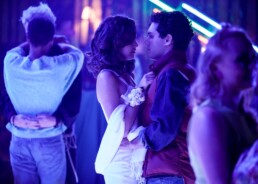
“Riverdale,” for example, shut down during the final moments of its characters’ senior year in high school — a prom was filmed; graduation was not. Roberto Aguirre-Sacasa, the showrunner of the CW series, has plans to feature mannequins in the audience at graduation, but not in love scenes. In fact, it’s likely the program’s performers will be showing a lot less skin.
“There’s a weird retro 1950s vibe to ‘Riverdale,’” Aguirre-Sacasa said. “One of the things we sometimes do is suggest sex through coded language — I think we’ll almost lean into that melodrama and suggestive behavior.”
The series, like others, will also feature more “bottle episodes” — a term that describes an installment that dives deep into the story of one or two characters, often with a limited number of sets — in order to help manage the number of people present during filming. But don’t expect to see Archie and Veronica practice social distancing.
“We’ve done mysterious diseases, so my hope is that ‘Riverdale’ will be an escape from the real world, rather than a reflection,” Aguirre-Sacasa said. A previously planned five to six-year time jump in the plotline will also help skirt the coronavirus issue.
“Legacies,” a young adult drama about vampires and the vampire-adjacent, did not have a chance to film a long-anticipated romantic reunion between two of its main characters before production ceased. (To name them would spoil the show and inflame millions of fans.) That’s been weighing on the mind of Julie Plec, an executive producer who is strategizing how to deliver this payoff in a pandemic.
“Twenty episodes is a long time for nobody kissing, so we have to look at the logistics of how we could make it work,” Plec said. “Maybe we can mount a separate intimacy unit that has its own quarantine and its own testing. Maybe we could just hire a crew that’s going to shoot our intimacy.”
This thinking is consistent with the suggestions in a “The Safe Way Forward” a 36-page document crafted in tandem by four major Hollywood unions: SAG-AFTRA, the Directors Guild of America, the International Alliance of Theatrical Stage Employees and the Teamsters. Among its recommendations is a “zoned” approach to production that limits the number of actors and staff on sets where the use of personal protective equipment isn’t possible. The unions also call for capping workdays at 10 hours to allow for more cleaning time, and Covid-19 testing for all cast and crew that ranges from weekly to rapid (in which results are delivered in 1-12 hours) for actors performing intimate scenes.
It’s the first time in decades that the four groups have released joint protocols. “We’ll definitely see an increase in specially trained professionals on set,” says Duncan Crabtree-Ireland, the chief operating officer and general counsel of SAG-AFTRA. He adds that intimacy coordinators — who became fixtures on many productions, in the wake of the #MeToo movement, to ensure the comfort and safety of actors — may also be trained in Covid-19 prevention techniques.
‘Everything Requires Fakery’
Of course, these problems are not just the province of teen shows. “The L Word: Generation Q,” Showtime’s revival of the groundbreaking series, premiered in December with a graphic 1 minute 20-second long sex scene. These types of moments that can only be depicted on premium services have become a hallmark of the program, which has presented a challenge to the showrunner Marja-Lewis Ryan as she and her staff plan the second season.
“I try to write in two different phases.” Ryan said. “I write the dream first and then somebody tells me ‘Your dreams can’t come true.’ Then I try to figure out: What is it about this dream that really matters to me? And I make adjustments from there.”
“My independent film background is going to be really imperative, because in that world you hear ‘no’ all the time,” she added. “I do like puzzles, so maybe it’ll be OK.”
Ryan, like many of the other producers interviewed for this story, is considering limiting guest stars and background actors — it’s going to be a tough time for anyone who makes a living as a television extra — and hiring cast members’ real-world partners. (“The Bold and The Beautiful” has already done this.) Multiple “L Word” stars are dating or married to people who “also happen to be very good actors,” Ryan said.
“Our joke is I’m going to have a lot of wigs, and I’m just going to be in every scene,” she added.
Wigs aside, TV’s showrunners are examining how some cinematic sleights of hand could give the illusion of intimacy. Avoiding romantic situations really isn’t possible on Netflix’s series, “You,” which stars Penn Badgley as a hyper-literate, unhinged stalker with a mounting body count in constant pursuit of his “true love” — so far a different woman each season.
“Smoke and mirrors,” the “You” showrunner Sera Gamble said, “are basically the entire job description of making cinematic entertainment. Everything requires fakery.” (Gamble knows something about cinematic shenanigans — she also ran “The Magicians.”)
“You’ve definitely watched a scene where two people are speaking intimately and not noticed that you’re looking over a stunt double’s shoulder, for example,” she continued. “This season, our particular job is to say, ‘Everybody think of 100 percent of everything you’ve ever done to make something look a certain way on camera, because we’re going to work our way through all of it.’”
The past offers lessons on how not to handle the filming of intimate scenes during an epidemic. The last time Hollywood confronted this issue was in the early 1980s, before many people fully understood how AIDS was spread.
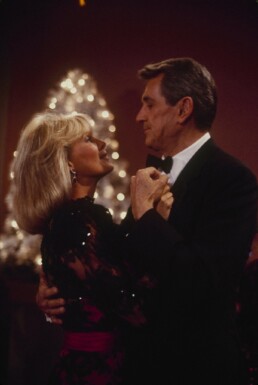
One of those people was Rock Hudson, who had joined the cast of “Dynasty” in 1984 as a love interest for Linda Evans’s Krystle. After reading a script in which his character was supposed to passionately kiss Evans, he agonized over whether to tell the series producers and his co-star that he had AIDS, according to his autobiography, “Rock Hudson: His Story.” Ultimately he did not — instead he gargled lots of mouthwash and performed the kiss with a closed mouth.
As Evans wrote in her own memoir, “Recipes for Life: My Memories,” her puzzlement about “why his kiss was so passionless” gave way to clarity “when the news broke that he had AIDS. In retrospect, it was incredibly touching how hard he tried to protect me.”
This piece of television lore hasn’t come up in conversation among the actors of the CW’s “Dynasty” revival, the showrunner Josh Reims said. Like its predecessor, the show, which was forced to end its third season without filming an eagerly awaited wedding, is known for its sexy, soapy antics. This has Reims and the other writers reaching for creative solutions.
“Phone sex has certainly come up a lot” Reims said, laughing. “I was looking through the first episode written before all this, and basically removed everything that said, ‘And then they kiss.’”
“The joke among the writers,” he added, “is that we will watch two characters say they want to have sex and then cut to them saying, ‘That was some great sex.’”
Reims is hoping that when the show returns to the air next spring, Covid-19 — and the challenges of plotting and filming intimate scenes — will have subsided. Regardless, you won’t see the Carringtons in face masks.
“No one,” he said, “is watching ‘Dynasty’ to be reminded of a pandemic.”
A version of this article appears in print on July 19, 2020, Section AR, Page 12 of the New York edition with the headline: Pandemic TV’s Illusion of Intimacy.

Matt LeBlanc Is A Happy Man
This article first appeared in Watch!.
Matt LeBlanc has millions of fans around the world, but as the Man With A Plan star has learned, sometimes the toughest audience is under the same roof. Recently, he asked his 15-year-old daughter, Marina, to name her favorite character on the CBS sitcom. She answered without hesitation: Stacy Keach’s Joe. “I was like, ‘Really, not me?’ And she said, ‘Well, you’re OK,'” the star says with a laugh. “I think she gets enough of me.”
Bringing relatable, humorous moments like this to viewers is what originally drew the 52-year-old actor to the series, now entering its fourth season. LeBlanc’s character Adam Burns is a kindhearted, married father of three who often finds himself exasperated by his brood, be it a daughter who says she wants to become a vegan (Grace Kaufman), or his Mephistopheles of a sister-in-law (Jessica St. Clair), who says she wants to become a better person. (Both of them fail spectacularly.)

Sitting in an Italian bistro in the tony Beverly Glen neighborhood of Los Angeles, dressed in a blue-gray hoodie with Carhartt emblazoned on the sleeve (“Free from the show!” he gleefully proclaims) and Levi’s, a black Porsche baseball cap pulled down low, LeBlanc has learned to draw as little attention to himself in public as possible. “It’s weird to go into a room full of strangers and everybody knows your name, what you do for a living, and how much money you make,” he says. “But it’s been long enough now that it doesn’t really bother me anymore.”
These days, the actor navigates fame with the same professionalism that he consistently brings to his work, the latter of which he credits in part to Man‘s stellar ensemble. “We have a cast where you can hand the ball to anyone and they’ll run it into the end zone.”
He’s got that right. This warm sweater of a sitcom features a rich cast of pros including Yes, Dear’s Liza Snyder as Adam’s wife, Andi (“Liza gives as good as she gets,” says LeBlanc); Saturday Night Live vet Kevin Nealon as Adam’s older brother, Don (“He’s 800 feet tall, but just a sweetheart of a guy,” quips the actor); and legendary badass Keach as Adam’s father. (“He can make anything funny. Who knew? This is a guy who made a career out of playing a tough guy.”)
Matt LeBlanc knows all about making a career playing against type. Often cast as the lothario, the actor has a full understanding of the responsibility that comes with his job. “It’s funny to be the lead,” he says. “There are things that you don’t realize when you start out. I set the tone. If I’m late for work, pretty much everyone is going to be late for work. So I can’t be late,” he says. “I can’t be unprepared. I have to always be thinking. And we have to work really hard to set the tone for everyone else.”

In addition to his on-screen role, LeBlanc serves as an executive producer alongside the husband-and-wife writing team of Jeff and Jackie Filgo, who wrote for That ’70s Show. Not only do the trio bring their experiences as parents to the comedy, but they have infused Adam with elements of LeBlanc’s own life. “My whole career, I never played a guy in a relationship. I never played a dad,” he explains of his decision to sign on. “I thought, Nobody’s getting any younger. This is what my life is now.”
Before he co-starred alongside an 800-foot man, and before his daughter preferred Stacy Keach to her father, LeBlanc grew up in an apartment in Newton, Massachusetts, a suburb 20 minutes outside Boston. “I was the only child of a single mom, so I spent a lot of time in front of the TV,” he says. “I watched All in the Family, The Honeymooners, even Cheers and Taxi. Those were family sitcoms as well. In Cheers, the bar was their living room. And in Taxi, the garage was their living room and Louie was the dad.”
He also fondly remembers those eagerly anticipated “snow days,” when kids wake up before dawn, turn on the TV, and watch a scroll across the bottom of the screen to find out if their school is canceled for the day due to inclement weather. “I went to public school, and all the private schools would get the day off if there were flurries,” he says. “I was like, ‘That’s bulls–t, man.'”
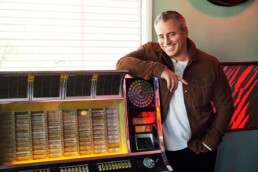
LeBlanc’s mother, a former office manager, and much of his extended family still live outside Boston, and if you listen closely to his low, gravelly voice, there’s a hint of a pahk yah cah in Havahd Yahd accent that emerges when he’s getting ready to tell a story about his days working construction. He learned the trade in high school and at Wentworth Institute of Technology in Boston before he dropped out, and he gifted the profession to his Man With A Plan character, Adam.
“I worked with this guy in Florida. The payday was Thursday. By Friday he was broke,” he says. “He would get his check, go to the bank, cash it, and then go straight to the bar and spend all his money buying everybody drinks. But he wasn’t a very good carpenter. He’d use a big 32-ounce giant hammer. He said he used it because he didn’t have to swing it that hard. One day,” he continues, “he hit his thumb with it; it looked like a ketchup packet. It just split open like that and burst.” LeBlanc bandaged up the gory appendage and shipped the guy off to the hospital.
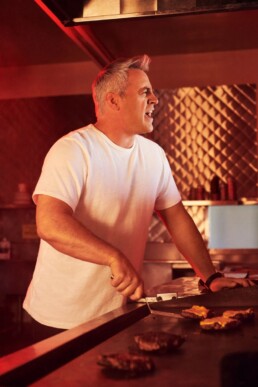
Let it be known that LeBlanc knows a thing or two about ketchup, having appeared in a Heinz commercial early in his career. In fact, YouTube is full of ads from the late 1980s and early ’90s starring LeBlanc (Coke, Cherry 7UP, KFC, and some cereal concoction called Fruitful Bran—RIP).
But his first break came with a CBS show called TV 101 about a group of high school students and aspiring journalists. LeBlanc played a jock named Chuck Bender, who, among other things, loses his virginity to the Chariots of Fire theme. Hints of his signature humorous delivery are evident. The show succeeded in getting LeBlanc out to L.A. in 1990; a flurry of short-lived series followed, including a Married…with Children spinoff called Top of the Heap, which was canceled to make way for a Top of the Heap spinoff called Vinnie & Bobby, in which LeBlanc played … you guessed it … a construction worker.

Everyone is familiar with the next beat of LeBlanc’s story, and although he has been talking about the show for a quarter of a century—yes, the beloved sitcom premiered 25 years ago last fall—he seems completely at ease using the F word.
“It seems like every year, there’s a new generation that discovers Friends,” says LeBlanc, crediting the reruns that streamed on Netflix. “It’s been interesting to see how the show still feels relevant to kids. You watch an episode where you pick up the phone and pull the antenna out to make a call. There’s no texting anywhere. There are no current events. We did one topical joke in 10 years—one.”
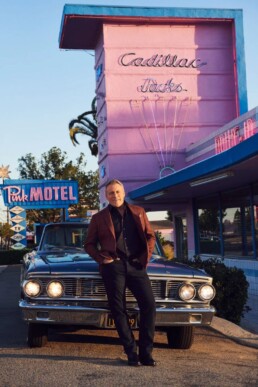
When Friends and its short-lived spinoff Joey ended, LeBlanc had planned on a year-long hiatus, but “it ended up being five or six,” he says. He values that time because he got to spend it with his daughter (whose mother is LeBlanc’s ex-wife, Melissa McKnight), taking her on camping trips in their motor home and teaching her how to swim. “The years just ran together.”
Then he got a call from Friends creator David Crane and his romantic/writing partner Jeffrey Klarik: The creators wanted the actor to play “Matt LeBlanc,” an exaggerated, flawed, louche version of his public persona whose life becomes entwined with a British husband-and-wife writing team. Thus Episodes was born, and the unflinching look at fame, ego, and the TV business became one of the most critically acclaimed comedies of the past decade. If you haven’t seen it, put down this magazine and start streaming it on SHOWTIME ANYTIME. It’s that good.
“People always asked me if I worried about being the brunt of the joke,” he says of his time on Episodes. “I’ve always said, ‘If it’s a good joke, no. If it’s a s—t joke, let’s rewrite it.’ If it’s funny, you get away with saying a lot of things. And that was one of those projects where it was really hard to get through things with a straight face.”

Episodes was so funny that it led to a Golden Globe win in 2012 for the actor—and a lot more work. Its final season (filmed in London and L.A.) collided with his hosting gig for the British racing reality show Top Gear and the filming of the pilot for Man With A Plan. You could get jet lag just reading about LeBlanc’s description of that time. “I had no personal life,” he recalls. “It was funny because it came at a time when I didn’t really need the money. How ironic is that? I wish that it had come when I was younger and wasn’t a dad. It would work much better to be saying, ‘Yeah, I’ll go to Japan and then Kazakhstan and then Morocco and then Norway and then Italy and then France and then Spain.'”
Man With A Plan‘s taping schedule is much more manageable for LeBlanc, allowing him to spend time at his working cattle ranch north of Santa Barbara, California, where he rides horses, goes camping, and road trips on his motorcycle. “I’ve been quoted before saying that I’m really good at doing nothing. Now, my ‘nothing’ may not be someone else’s ‘nothing,'” he jokes. “I’m not just lying there breathing. I’m just not working.”
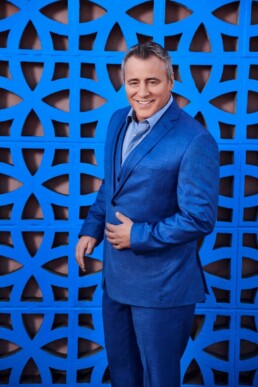
At this stage in his life, Matt LeBlanc knows he owes no explanations or apologies, and he’s old enough to be grateful for what he has without wanting more. “I wish I could have been more content when I was younger,” he admits, “but nobody is content when they’re young.” Now, “I’m at the point in my career where I’m not looking to further things. I want people to watch the show. But I’m not looking at it as a steppingstone. I’m not looking to be an A-list movie star. I’m happy where I am. I feel successful,” he says. “And I feel fulfilled.”

Whatever Lola Wants
This article first appeared in Watch!.
TYPE THE WORDS “Simone Missick” into Google and the first prompt you’ll see is, well, “Simone Missick.” The second result is “Simone Missick, arm.”
Let us explain.
For two seasons on Netflix’s Marvel’s Luke Cage, Missick played Misty Knight, a New York cop whose arm is gorily (and kind of gloriously) amputated in an epic battle; she receives a bionic replacement infused with all sorts of superpowers. But to hear Missick tell it, the two-pound prosthetic didn’t make her feel very forceful.
“It was the most painful process!” she remembers. “They had to remake that arm about 20 times because I was like, ‘Guys, I can’t move my elbow. How am I going to punch people if I can’t reach for my gun?’ So we went through several generations. It’s like the iPhone. They just kept upgrading the arm.”

Now Missick, 37, is doing some upgrading of her own, throwing her weight behind a black robe to star in the poignant, topical, and very funny CBS legal drama All Rise. Missick plays Lola Carmichael, a former district attorney who is elevated to a judgeship at the Los Angeles Superior Court. Dubbed “The Lolacoaster” by judicial assistants, Lola is fast-talking, whip smart, dedicated—and a little uncoordinated: This is a woman who trips over her robe as she’s climbing to the bench for the first time. In fact, she may remind you of another iconic legal heroine, Ally McBeal. “I grew up loving these shows that had fast-paced characters who think fast and speak even faster. This show is that,” says Missick, who, dressed in a light coral dress, gold hoop earrings, and flip-flops, looks impeccable even after a long day of work. “This is a woman who’s strong and capable, yet awed and clumsy,” she continues enthusiastically. “She’s got the heart and passion to make a change in her community.”
All Rise’s tone is as intricate and nuanced as the legal system it explores. The pilot alone featured a courtroom shooting, a thwarted theft, a defendant hell-bent on self representation, some police corruption possibly aided and abetted by Lola’s boss, Lisa (played by CSI vet Marg Helgenberger), and lots and lots of coffee. Aside from the cases of the week, the series, created by actor-turned-producer Greg Spottiswood, explores the foibles and personal lives of the judges and attorneys who inhabit the courthouse each day.
This tonal hybrid means that Missick might be called on to portray, as she says, “seven different types of emotions in one scene. We have comedy and we have drama in the same moment. I think those are the things that make this show stand out. For me it’s like Christmas every day when I come to work,” she continues. “I went to school and studied theater. This is the show that’s the closest that we’re going to get to it in primetime television.”

MISSICK IS BEING INCREDIBLY MODEST. SHE DIDN’T JUST go to any school to study theater; after graduating from Howard University, she attended a British American Drama Academy program in Oxford, England, where she took classes from the likes of Alan Rickman and Ben Kingsley.
She then returned home to Detroit to scrape together enough money to move to L.A. The actress, whose mother is a retired social worker and father is a retired adult education teacher, still has close ties with the city: Her cousin lives in the house Missick grew up in, and her sister resides in a nearby suburb. (She also has a brother and nephew in Burbank, and her parents and aunt relocated to the L.A. area, which means family is nearby.) “Growing up in Detroit, there’s a certain level of strength and confidence that I was given in a community where people embraced me for who I was, and that confidence is something that all the characters I keep coming into contact with have,” she says.
Missick arrived in L.A. in 2005, finding personal fulfillment more quickly than professional success. She and her future husband, actor Dorian Missick, met at an audition in 2009. “He was behind the table. He was helping a friend who was producing a web series in which he was going to direct an episode. I didn’t get the job, but I got the man, so I’m good,” she laughs. The two wed in 2012.

Almost 10 years to the day after she moved to L.A., Missick landed her first major role—that of Luke Cage’s Misty. She moved to New York City for four years to play the part on Cage as well as its sister series, Iron Fist and The Defenders. For those not versed in comic book lore, this casting was a huge deal.
Misty was the first African American female superhero ever created—in 1975 by Tony Isabella and Arvell Jones—and Missick was the first actress to play her on live-action TV. No pressure there, right? “Misty was such a gift,” Missick says. “To be the first person to give her voice and to have this built-in network of fans that have been around for 40-plus years waiting to see her come to life was amazing.”
The character is so beloved that the pesky bionic arm has been put up for auction and is predicted to fetch between $10,000 and $12,000, according to Marvel’s auction site. “If I had known they were going to sell it for 10 grand, I would have taken one and said, ‘You guys have three or four more!’” she jokes.
Cage became a personal show for Missick, as it allowed her to act opposite her husband, who played an ex-felon named Cockroach. But to hear Missick recount the story, that collaboration wasn’t exactly a high point of their marriage. “Dorian and I have extremely different processes. And we were playing different characters. His character is this loud, bombastic gun seller. To get ready, he’s listening to a lot of hip-hop and rap. My character just lost her arm. She’s no longer a cop. She’s grieving. So my husband is like, ‘I want to come hang out in your trailer before we start filming.’ He’s in there playing music, and he’s loud and obnoxious, and I’m just getting angrier and angrier.”
Their first scene together required Missick to slam Dorian against a gate. “I think I tried to break his arm because I was like, ‘You were too loud in my trailer,’” Missick jokes. “Irrespective of him being my husband, I think he’s a wonderful actor, so it was great to play opposite someone I could trust.”
Once Luke Cage wrapped, Missick wasn’t necessarily looking to play another badass, so of course that’s exactly what happened: She landed the role of Trepp, a tough bounty hunter on Netflix’s futuristic sci- series Altered Carbon, after taping an audition from her basement. “This was the first situation where I would get the scripts and I wouldn’t have any thoughts or notes. Partially because it’s set 400 years in the future and you’re like, ‘Well I don’t know if people would actually do that,’” she says. “Then the other part was a testament to the writers. They were always on set if something didn’t make sense. To me that’s the testament to great television. People who want to tell great stories recognize you can’t just tell these stories in a vacuum. You can’t just say, ‘Well, I came up with this episode, and I wrote it seven weeks ago, so you have to just stick to what I said.’”

BACK IN THE PRESENT, Missick realizes that All Rise—or more accurately, her lead role in it—wouldn’t have existed as recently as eight or nine years ago. After all, when Kerry Washington took on the part of Scandal’s Olivia Pope in 2012, she was the first African American woman to lead a primetime network TV drama in almost four decades. “Thank God for [Scandal creator] Shonda Rhimes and Kerry Washington, and [How to Get Away with Murder’s] Viola Davis. Had it not been for Kerry, and Viola with her Oscar showing you what was what, we would not have these opportunities,” says Missick. “But I’m also thankful for CBS and Greg Spottiswood and our producers, who said, ‘You know what? They had something good going on over there. Let’s bring that to our audience.’”
The success of Washington’s and Davis’ shows has not led to a boom of TV programs with African American female leads; even seven years later, Missick is just one of a few who have had the opportunity to helm a series—a responsibility she takes very seriously. Missick says she created a character “bible” for Lola that contained biographical information, a career backstory, and thoughts about her family—although the family parts were quickly thwarted. “In episode 2, our writer had Lola call her mom ‘Mother,’ and I thought, ‘Oh, that’s a different type of relationship. That’s not ‘Mom’ or ‘Mamma.’ So I called Greg, our creator, and said, ‘What’s up with this?’ He told me the idea that they had for who my mom is and the kind of woman she is. It’s not at all what I thought.”
She has looked to the real world for inspiration, too, studying up on Supreme Court Justice Ruth Bader Ginsburg (who was name-checked in the pilot, but to our knowledge has never tripped on her way to the bench), as well as Vonda Evans, a recently retired judge on the Wayne County Circuit Court in Missick’s native Michigan, who is known for her fiery opinions. Missick is heartened that All Rise feels incredibly current and rooted in real-life events, thanks to the 2018 midterms, when a group of 19 African American women were elected to judiciary posts in the Houston area. “We have never seen a black woman on TV like this,” Missick says, “and I relish being able to do it.”


Kelly Clarkson Plots World Domination
This article first appeared in Entertainment Weekly.
With the pop star’s upcoming tour, a new talk show, and her continued work on The Voice, 2019 is shaping up to be the year of Kelly.
According to well-studied laws of atmospheric science—and pop culture— the more Kelly Clarkson in the ether, the better it is for the universe. Benefits include: aural pleasure, laughter, and an abundance of Voice champions. (After all, she’s coached two in a row to victory— most recently Chevel Shepherd.)
Clarkson, 36, is embarking on her first tour in almost four years; launching a syndicated talk show this fall; recording music for UglyDolls, in theaters May 3; and continuing her stint as a coach on The Voice. All the while, she’s raising four children with husband Brandon Blackstock—two kids under 5 and a teen and tween from Blackstock’s previous marriage.
The Texas native will haul the whole family—including her dogs—on her Meaning of Life tour, a 28-date stint that kicks off Jan. 24 in Oakland with opening acts Kelsea Ballerini and Brynn Cartelli (one of Clarkson’s protégés who won The Voice). Clarkson teases that it’s “the longest show I’ve ever had,” because “winnowing down 16 years of songs is tough!”
The set list will include all of your “Miss Independent Breakaway Since U Been Gone Stronger” favorites— “I hate when people go to shows and [the performers] don’t play their hits,” she quips—as well as a medley of tunes that people often request but she’s unable to get to. In addition, if you’re a fan of the “Kelly Clarkson covers Broadway hits” genre, you’re in luck, as she plans to devote a part of the night to her inner show-tune geek.
Clarkson’s live shows have probably become best known for her covers of other artists’ songs—many of which explode into viral sensations. Last time around, Clarkson memorably took on Nick Jonas’ “Jealous,” Demi Lovato’s “Cool for the Summer,” and “Purple Rain,” no artist name needed. (This is the point where you should put down this magazine, pick up your phone, Google “Kelly Clarkson, Purple Rain,” and have a listen. We’ll wait.)
For the Meaning of Life tour, Clarkson has culled fan requests from social media and will perform covers during a segment she’s calling “A Minute and a Glass of Wine.” Expect to hear her take on Ariana Grande’s “God Is a Woman” and Eva Cassidy’s arrangement of the Fleetwood Mac standard “Songbird.” And, she teases, “I have this really cool Cardi B idea that I hope pans out.”
The tour wraps up at the end of March, which will likely dovetail with the start of live episodes of season 16 of The Voice. She then dives into rehearsals for The Kelly Clarkson Show, which will air as a companion to The Ellen DeGeneres Show in many markets. Clarkson grew up watching Oprah but says she never thought of fronting a talk show until one of NBC’s top executives said, “We just need a show with you. You don’t have a filter.” That led to the taping of a pilot, and the voluble star says she felt immediately comfortable with the format. “I didn’t think it was going to go that way, but I did my homework and I really enjoy talking and it was really, really fun.” She will open each show with a song, and promises a blend of celebrities, real people, skits, and games.
The singer-songwriter apparently enjoys a hectic life, because she insists she’ll continue as a judge on The Voice even as her daytime series launches in the fall. “My studio for my [talk] show is a golf-cart ride away on the same lot [as The Voice], so I have a lot of help in that aspect, scheduling and stuff—and they know I work pretty quickly,” says Clarkson, who also speaks pretty quickly. “The Voice is a well-oiled machine 15 seasons in. I think it’s going to be doable.” If nothing else, she’s doing her part for planet Earth.

Real World star Danny Roberts opens up about living with HIV and the costar he turned to for support
This article first appeared in Entertainment Weekly.
You may remember Danny Roberts from The Real World: New Orleans back in 2000. He was the charismatic, handsome — and remarkably rational — gay man who inadvertently became a poster child for the movement against the “Don’t Ask, Don’t Tell” policy that banned gays from openly serving in the military. Roberts was dating an officer and MTV obscured the boyfriend’s face so he wouldn’t be discharged as more than 1,200 servicemembers were that year.
Roberts more or less retreated from the public eye after his trip through the MTV reality machine. Now 41, he recently moved to New York City where he works as a digital design recruiter and is a father to an adopted 2 1/2-year-old girl. He is also living with HIV — something he’s revealing publicly for the first time exclusively to Entertainment Weekly.
“The reason I want to share this story is that I spent so long battling and beating myself up for my own misconceptions and bigotry,” he says. “It is difficult to admit the negative feelings you had about a set of people and state of being based on made-up stories.”
Roberts says he found out he was HIV positive around 2011. One weekend, he had passed out and woke up in a pool of blood. Concerned, he called his doctor and told him what had happened. The doctor had given him a check-up the previous week and knew Roberts was HIV positive but was planning on telling him in person the next day. Instead, he delivered the news to Roberts over the phone. “My first reaction was shock. Then I was angry, then lots of denial,” he says. “Those early years were very difficult and very lonely. You don’t know whom to turn to have conversation and people don’t know what to say. It’s not something that people have experience with,” he explains. “There’s also the potential likelihood of massive judgments about what behaviors led to this and what kind of people this happens to.”
The Georgia native is forthright, articulate, and introspective as he talks about living with HIV. He has obviously done an enormous amount of research and reflection. “The last thing I ever want is pity. I just want people to know and be aware. I knew so little myself so I get it.”
Fortunately, Roberts has been “undetectable” since his diagnosis, which means that a person’s viral load is so low it can’t be measured by a blood test and, according to the Centers for Disease Control and Prevention, that the virus can’t be sexually transmitted from one person to another.
In recent years, there’ve been some terrific advances in combatting the disease, including a treatment called “PrEP,” which has proven effective in reducing the spread of HIV. “Medicine has come so far — it’s incredible where we are and where we could be not far in the future,” he says. In the meantime, he says living with HIV is like, “having a crappy old cell phone with a huge app eating your energy.”
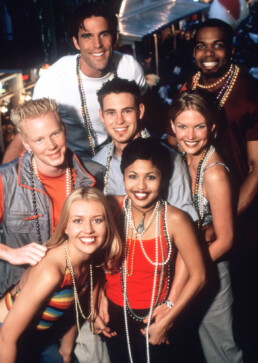
Roberts says he’s thankful for the friends he has been able to lean on including his Real World costar Kelley Limp, who went on to marry actor Scott Wolf. The two are still very close. “She’s my life sister,” Roberts says. “She was one of the first people I turned to and talked to. She has been strong and helped me through this.”
During his time on the Real World (which MTV is rebooting and will stream on Facebook Watch), Roberts put a blurred face to “Don’t Ask Don’t Tell” and in doing so taught the country about its adverse effects. Now, on the eve of World AIDS Day (Dec. 1), he wants to reignite discussion about a disease some assume has abated — even though almost 40,000 people in the U.S. receive HIV diagnoses each year. He also hopes to help others avoid the pain he endured. “I had so many negative feelings I was forced to face,” he says. “I’ve been on such a journey to overcome that. In a way, this has really been like my second coming out.”
For more information on HIV, visit the Centers for Disease Control and Prevention. And if you wish to spread some holiday cheer, please consider donating to the Elton John AIDS Foundation or amfAR.

'How I Met Your Mother' from A to Z
This article first appeared in Entertainment Weekly.
A deep dive into the customs, catchphrases, and artifacts that make ''HIMYM'''s world rich, colorful, crazy — and totally worth obsessing over
A | Apartment Roller Luge
The game Robin invents to console Lily and Marshall over the slanted floors in their new apartment. Equipment needed: a skateboard, a metal salad strainer, and an open doorway.
B | Blue French Horn
The instrument hanging in the restaurant where Robin and Ted have their first date. ”That horn is the pilot to me,” says Smulders. ”We haven’t made reference to it in so long. It’s a Horcrux of the show.” (For you non-Potter geeks, that means it’s, like, super-important.) Now hangs in co-creator Craig Thomas’ office.
C | Cockamouse
The flying mouse/cockroach hybrid that sets up shop in the gang’s apartment. Also one of Segel’s favorite episodes: ”The episode makes me laugh like crazy,” he says. ”We got to shoot it like it was a horror movie and overact, which I love.”
D | Doppelgängers
Each of the gang has a ”twin” revealed over seasons 5 and 6. Stripper Lily, Lesbian Robin, Señor Justicia (a mustachioed Marshall), Mexican Wrestler Ted, and Dr. John Stangel (Lily’s fertility doctor, who’s a ringer for Barney with a beard). Also the subject of Smulders’ fantasy episode: ”I wish we could do an episode that is just the doppelgängers. Their lives would intersect as well. That’s the show I want to watch!”
E | Eighty-Three
The number Barney always uses when inventing a statistic. Example: ”There is an 83 percent correlation between the times men wear boutonnieres and the times they get laid.”
F | Fiero
Marshall’s beloved Pontiac, which ends up in the Big Parking Lot in the Sky when it conks out just shy of 200,000 miles. A Cassingle of the Proclaimers’ ”I’m Gonna Be (500 Miles)” is stuck in the tape deck. ”I love that you have all these flashbacks that fill in the blanks…which tell how everyone met everyone,” says Radnor of the episode, which is one of his favorites. ”There’s something so sweet and hilarious about that.”
G | Gary Blauman
Barney’s colleague played by Smulders’ real-life husband, Taran Killam. Blauman makes a public show of quitting his job by trying to pee on the conference table during a meeting. (Damn, pee shyness!) According to Barney, Blauman lost all his money soon after. ”Then he became a janitor at an old folks’ home and moved into a one-room apartment above a bowling alley…. He died.” Problem is that Blauman pops up again very alive in subsequent seasons. (And rumor has it that he’ll show up in season 9.) A side note: Most of the cast’s significant others have guest-starred on the series during its run: David Burtka, Harris’ partner, recurs as Lily’s high school boyfriend Scooter, and Hannigan’s husband, Alexis Denisof, appears as Robin’s co-worker, blowhard newscaster Sandy Rivers.
H | Hot/Crazy Scale
A graph created by — guess who? — Barney. The X axis represents ”crazy” and the Y axis is ”hot.” The goal is to date women who, when plotted on the scale, are above the diagonal.
I | Interventions
After attending an alcohol-related intervention for their friend Stuart (Matt Boren) in season 4, the fivesome adopt the model to help one another kick other destructive habits — everything from Lily’s ”weird fake English accent” to Marshall’s Dr. Seuss hat. A red-and-white banner is hung. Sometimes there’s a poem. Or a pun. Also Radnor’s favorite recurring gag. ”You can tell that the characters take them so seriously. They go to great lengths with the production value — like the banner comes out. The character never thinks it’s for him or her — but it always is.”
J | James
Barney’s gay half brother, played by Wayne Brady. In this season’s opener, watch for James to perform the most amazing/disturbing wedding number aired on TV.
K | Karate Kid
Toward the end of season 8, Barney is disappointed when the gang invites Ralph Macchio to his bachelor party instead of the ”real” Karate Kid, Billy Zabka. But at the end of the half hour, a clown wipes off his makeup to reveal he’s actually Zabka. ”The ’80s have this weird canonical importance to us,” says co-creator Carter Bays. ”The first time I saw Zabka there was a feeling of ‘Oh, s—, this guy is going to beat me up.’ But then you meet him and he’s totally cool.” Meanwhile, Hannigan had her own fan moment: ”There was hardly any acting required on my part when I was obsessing over Ralph Macchio.”
L | Legendary
First uttered by Barney in season 1, episode 3. Best variation: ”Legen — wait for it, and I hope you’re not lactose-intolerant ’cause the second half of that word is — dary.”
M | MacLaren’s
The neighborhood bar is a second home for the gang. Based on McGee’s in NYC, it employs bartender Carl MacLaren (named for Bays and Thomas’ former assistant; played by Joe Nieves).
N | ”Nothin’ Suits Me Like a Suit”
In the show’s 100th episode, Barney must decide whether to give up suits in order to bag MacLaren’s hot bartender, played by Stacy Keibler. He chooses his suits over his suitor. The episode ends with a pull-out-the-stops musical number — an homage to Gene Kelly’s ”Singin’ in the Rain” (minus the precipitation).
O | Ohio
The home state of Ted and his real-life alter ego, Bays. Says Radnor: ”One of the greatest lines I ever got to say on the show was [in season 2, episode 17] when Marshall asks Ted, ‘You live in Ohio, right?’ And Ted says, ‘My parents live in Ohio. I live in the moment.”’
P | Patrice
Robin’s persistently chipper co-worker/nemesis at World Wide News, played by Ellen D. Williams. Target of Robin’s wrathful catchphrase ”Nobody asked you, Patrice!” which some complete genius has set to a techno beat and posted on YouTube. Smulders was reluctant to carry out this gag at first. ”Ellen, who plays Patrice, is the sweetest person on the planet. She literally just gave me a gift bag of coloring stuff for my child. She makes things for our crew. She kind of is Patrice,” she says. ”I had a hard time with Patrice. I needed a pep talk from the writers. They were like, ‘It’s totally fine. Patrice is that one person in your life that you can’t stand and you’re totally in the wrong about it. It’s human behavior.’ It was so heartbreaking to yell at her. But I really like having Ellen on the show, and if yelling at her means we get to keep her, that’s great.” Patrice’s photo is pasted on the bay of monitors that the director and writers watch when filming. She’ll return in season 9.
Q | Quinn
Barney’s stripper fiancée in season 7, played by the terrific Becki Newton. ”Quinn’s” is also the name of the restaurant where Ted picks up wings for the gang’s Super Bowl party in season 2. ”That’s a surprise to me!” says Thomas. ”That’s just Carter and me liking the name. It wasn’t some amazing call forward. Actually, Carter and I have a screenplay that had a character by that name, too.”
R | Robin Sparkles
The gang discovers, much to everyone’s joy, that Robin was a teen pop star in Canada. (Thanks, Alanis Morissette, for the inspiration!) Her one hit, ”Let’s Go to the Mall,” is an ’80s-inspired bonanza. Follow-up flops include ”Sandcastles in the Sand” and the edgy ”P.S. I Love You” (as Robin Daggers), which recounts Robin’s unrequited obsession with Paul Shaffer. ”Being in a recording studio, where I never find myself, it was a great change of pace,” says Smulders. Sparkles’ band is stuffed with current and former HIMYM crew, including Matt Kuhn on drums, Jamie Adamic on keytar, David Baker on guitar, and the real Carl MacLaren on keyboard.
S | Slap Bet
Following an elaborate series of bets you’d need a Ph.D. in slapology to understand, Marshall wins the right to wallop Barney a number of times across the face. The show went to town with this, even creating a Slap Bet Countdown (theslapbetcountdown.com) timed to the third slap. ”One of my favorite things in comedy is when something has been so intricately constructed that is so fundamentally dumb, and I think the slap bet is like that,” says Thomas. ”We’ve made this entire mythology.”
T | Two-Minute Date
Comely dermatologist Stella Zinman (Sarah Chalke) complains she has only two minutes for lunch, so in season 3 Ted takes her on a two-minute date, complete with a cab ride, meal, and movie — all filmed in one take. Bays explains how a show known for its quick scenes pulled this off: ”The day of shooting it felt like orchestrating the moon landing. It was fun seeing everybody working like a clock. The final product was this sweet romantic moment,” he says. ”If you pick two minutes of the entire series that tell what the show is, I’d select those two minutes.”
U | Urinal
Where Ted and Barney met for the first time in 2001.
V | ”Vomit-Free Since ’93”
Ted’s upchuck-free boast…which turns out to be false.
W | The Wedding Bride
A film by Stella’s ex-turned-husband, Tony Grafanello (Jason Jones), depicting the love triangle involving Stella (Malin Akerman), a saintly Tony (Jason Lewis), and Jed Mosley (Chris Kattan, hysterical as a louche version of Ted). The fifth-highest-grossing movie of all time and Kim Jong Il’s second-favorite film. In a flash-forward from season 7, Ted first professes his love to The Mother in front of a theater playing Wedding Bride III. ”I really liked the redundancy of the title,” says Bays. ”I can’t remember if this joke made it in, but the idea was that it was from the makers of Police Cop.” It didn’t, but it should have.
X | X, Dr.
Ted’s underground ”secret” radio persona at Wesleyan University.
Y | Yellow Umbrella
The talisman of the show, dreamed up in what Bays calls the ”very fertile” stretch in 2008 after the writers’ strike. Ted and The Mother attend the same Saint Patrick’s Day party in season 3. When Ted goes back to find his lost phone, he picks up the umbrella The Mother left behind to shield himself from the rain. Seasons later he returns it to The Mother, forgetting it at her apartment after a chat with her roommate, Cindy (Rachel Bilson). The color of the object, a sharp contrast to gray New York City, wasn’t an accident, says Bays. ”There are a lot of objects in primary colors on the show: the blue French horn, the red cowboy boots, the yellow umbrella. If there’s a spin-off of this show, it will be in the form of a children’s cereal.”
Z | Zoey
Ted’s girlfriend in season 6 (played by a post-House, pre-Once Upon a Time Jennifer Morrison), who opposes his plans to tear down the Arcadian hotel for the new Goliath National Bank headquarters. Just for kicks, here’s a list of the rest of Ted’s girlfriends, courtesy of the HIMYM office: Molly (Misti Traya), the girl Ted lost his virginity to; Karen (Laura Prepon); Natalie (Anne Dudek); Jen (Lindsay Sloane); Robin; Trudy (Danica McKellar); Victoria (Ashley Williams); Rachel (Busy Philipps); Blahblah (Abigail Spencer); Cathy (Lindsay Price); Strawberry (Gina Comparetto); Stella (Chalke); Cindy (Bilson); Amanda (Brooke Nevin); Royce (Judy Greer); Becky (Laura Bell Bundy); Naomi “The Slutty Pumpkin” (Katie Holmes); Carly, Barney’s half sister! (Ashley Benson); Jeanette (Abby Elliott).

The Mother of all Good-Byes
This article first appeared in Entertainment Weekly.
Kids, it was the fall of 2013, and a complex, delightfully outlandish sitcom called ''How I Met Your Mother'' was about to enter its final season; did we ever tell you the story of how it went from prime-time afterthought to beloved comedy iconoclast? Settle in...
Stage 22 on the Twentieth Century Fox lot has been the home of some horrific violence. This is where simians took over the earth in Planet of the Apes and again in a 1972 sequel. It’s also where Lee Majors and his rad two-tone truck nabbed the country’s worst felons on The Fall Guy. But all that brutality is tame compared with what’s occurring on a soundstage dressed up as a Long Island Rail Road train where two women — a redhead and a brunette — are rolling on the floor, locked in a vicious death match over…a cell phone.
The action breaks: ”She’s real, folks, she’s real!” exclaims Alyson Hannigan.
And that, kids, is how Lily met The Mother.
Yes, that Mother (Cristin Milioti) — the title character of CBS’ How I Met Your Mother and the woman we saw briefly in the train station at the end of season 8 holding the telltale yellow umbrella and asking for a ticket to Farhampton.
As with the best episodes of HIMYM (pronounced Him-Yim), let’s start with the end: By the series finale this spring, Ted will meet The Mother. She will have a real name, instead of being known by a word that is usually followed by Earth, Teresa, or Jones. We will discover whether Robin and Barney get married. The mystery of the pineapple from season 1 will be addressed. (”We managed to book the pineapple after some intense negotiations,” says co-creator Craig Thomas.) The final slaps will be doled out in a miraculous fashion. There will be plenty of jokes abooot Canada. The show might even birth a spin-off. In sum, it will be legen — wait five pages for it —
WHOOSH! It’s the fall of 2005. The biggest sitcoms on the air — Will & Grace, Malcolm in the Middle — are long in the tooth, and TV execs are searching for the next Lost or Apprentice (hey there, Martha Stewart!), not the next big comedy. ”We came along in an era where people were starting to question if the sitcom was even relevant anymore,” recalls Jason Segel. Starring two relative unknowns (Josh Radnor as Ted, the protagonist; Cobie Smulders as Robin, the object of Ted’s affection) and a trio of actors who were looking to expand beyond the roles that had defined them (Freaks and Geeks‘ Segel as Marshall, Ted’s best friend; Buffy the Vampire Slayer‘s Alyson Hannigan as his fiancée, Lily; and Doogie Howser‘s Neil Patrick Harris as Barney, a guy who never met an Italian suit or a C-cup he didn’t covet), the comedy looked like nothing else on the air. It was a multicamera show that didn’t shoot before a live audience. It crammed 50 to 60 scenes into an episode instead of the standard 15. And the pilot kind of spoiled the ending of the series when the narrator, Future Ted (voiced by Bob Saget), declared that Robin, the beauty we had watched Ted pine for, was not The Mother. It was as if The Sopranos had aired its final fade-to-black scene first and then asked you to watch the whole series.
People tried to pigeonhole the fledgling program: It stars quirky twentysomethings, so it’s a Friends rip-off! No, it’s Lost: The Sitcom because it’s about a group of people searching for their identities on an island. In reality, creators Carter Bays and Craig Thomas, who met at Wesleyan University, wanted to write a semiautobiographical comedy about their friendship. Thomas was Marshall — the guy who met his future wife, Rebecca, in college. And Bays was Ted, perennially on a quest for ”the one.” Regardless, HIMYM finished its first season in a glorious blaze of mediocrity — just outside the Nielsen top 50 behind Skating With Celebrities and Medium. To the cast and crew, that was okay. ”Too much attention too early in the run of a show cripples its creativity,” says Harris. The freedom of starting slow, he adds, ”allows for some creative, strange things and more elbow room.”
And strange things did start to happen. The show found fodder in loopy catchphrases, ’90s nostalgia, elaborately structured time-jumping episodes, and a deep mythology that eats up hundreds of pages of Internet wikis. (Is the Slutty Pumpkin HIMYM‘s version of Lost‘s Smoke Monster? Discuss.) The characters became more complex as the creators infused them with the real-life qualities of their stars. ”I’m quite certain that Craig and Carter think I’m Robin. They made Robin Canadian halfway through the first season because of me,” says Smulders. ”They called it ‘exotic,’ which is stunning and incorrect. ‘It’s going to be great, Cobie,’ they said. ‘We’ll talk about the wonderful things in Canada like universal health care and gun control.’ I think I got to make one mini-speech about it. Otherwise it was all abooot the accent — and Canadians being dumb and simpleminded. People love it, though. And Canadians do love it. I wish I was a teen pop star, but that definitely wasn’t in my past.”
Unfortunately, not everyone could be Canadian. So Lily’s adorable sensitivity and ”pregnancy brain” came from Hannigan; Barney became more emotionally rich, thanks to Harris’ range as an actor — and a magician, thanks to his ability to shoot fire from his sleeves; Marshall’s childlike wonder flowed from Segel (this is the man who lovingly rebooted the Muppets franchise, after all); and Ted got Radnor’s brains. In fact, if you want to talk feminist theory and how it relates to HIMYM, Radnor’s your guy. ”I’ve thought a lot about How I Met Your Mother in terms of an English paper,” he says. ”Like the whole show’s a gender flip, so Marshall and Ted are kind of like these gooey romantics and the women are these tough-talking, cigar-chomping, gun-toting, unsentimental characters. And then you have Barney, who is this kind of interplanetary parody of hypermasculinity.” (We told you he was really smart.)
While HIMYM was far from CBS’ highest-rated comedy, the show was one of the network’s youngest-skewing, which was enough to get it renewed. ”Never did they say, ‘Howie Mandel’s money-in-the-suitcase show is beating you. Introduce The Mother sooner,”’ says Thomas. After the writers’ strike in 2008, the show was one of the first to return to the air, roaring back with some of its strongest episodes ever (”Ten Sessions,” which included the two-minute date) and high-profile guest stars like Britney Spears who helped grab new viewers. Remarkably, its popularity has continued to grow in later seasons, which the cast and crew attribute to a 2011 syndication deal with FX and a pact with Netflix that same year. ”For the first six or seven years, I would be on TV every Monday night and I would never get recognized or approached,” says Smulders. ”It’s only been in the last year and a half. Syndication and Netflix have been huge for us. I will meet people who will tell me, ‘I just finished all seven seasons last night. I can’t believe I’m staring at you.”’
In May the show finished its eighth season in 15th place among young adults, with an average of 9.2 million viewers. To drum up excitement for this final year, the cast attended July’s Comic-Con in San Diego for the first time, and — somewhat unexpectedly for a series that features no goblins and only the occasional cape — the show’s panel was the most popular of the entire convention, according to a study by EW and General Sentiment. (In your face, Game of Thrones!) ”Comic-Con reminded us how many people really love the show,” says Bays. ”And it would be a shame for the party to end next spring.”
How’s that for a cliff-hanger?
WHOOSH! It’s the spring of 2013. A ninth season of HIMYM has recently been locked down — much to the surprise of the creators. After all, the cast’s careers have exploded since the start of the series. Segel is a prolific film actor and screenwriter (up next: shooting Sex Tape with Cameron Diaz); Hannigan, who is eager to do another sitcom once HIMYM wraps, appeared in American Reunion and is busy with voice-over work; Smulders smolders as Maria Hill in the Avengers franchise and cameos in the upcoming Marvel’s Agents of S.H.I.E.L.D. pilot; Radnor is a respected indie-film director (Liberal Arts); and Harris, who’s heading to Broadway this spring in a remounting of Hedwig and the Angry Inch, has a lock on hosting pretty much any awards ceremony on earth.
”We really thought for a long time we’d meet The Mother in the last episode [of season 8],” says Thomas. ”If you had talked to us last winter, we still would have sworn that would be the plan. Getting a ninth season was a huge game changer, and we realized we needed to extend the story. I think finding a way of showing The Mother to the audience but not to Ted was a nice compromise and a way to reward the fans.”
Picking an actress who could outshine the parade of women who have marched through Ted’s life — Ashley Williams as the much-loved Victoria, Sarah Chalke as Stella — was daunting. The creators knew they didn’t want to stunt-cast an A-list celebrity. ”TV is about discovering new people,” says Thomas, wisely. ”When you write a show for eight years called How I Met Your Mother, you better cast that fifth word of the title right.”
”Right” came in the form of Cristin Milioti, the 28-year-old Tony-nominated star of the Broadway hit Once. Thomas, Radnor, and director Pam Fryman, the show’s den mother who has helmed all but a handful of the episodes, flew to New York City for a performance to scout her and fell in love — just as they hoped Ted would. ”I left there thinking, ‘We found The Mother,”’ says Fryman. ”She slipped into this family like she’s been here since day one. She’s who we’ve been waiting for.” Adds Radnor: ”I met her a few days [after I saw Once] when she read with me. I read with two other actresses, but it was clear the creators really wanted her and she was the best person. I felt there’s a difference between someone who is Ted’s girlfriend and someone who’s going to be Ted’s wife. She’s a perfect choice because she has this innate warmth and sweetness.”
The Mother (still nameless) uttered only a sentence in the season 8 finale, but her appearance was shrouded in the secrecy accorded the presidential nuclear codes, the recipe for Coca-Cola, and the location of Jimmy Hoffa’s body. To film her pivotal scene, Milioti was shuffled around the Fox lot in a golf cart at night. There was no script, and the set was on lockdown; in fact, all the extras were cast members. Says Milioti of the high security, ”I got to feel what the Pope feels.”
WHOOSH! It’s July 2013. Stage 22. The pontiff is not working today. The action has moved from a Long Island Rail Road train to the interior of a plane. A different pair — Marshall and Daphne (Sherri Shepherd, playing the same character Sherri Shepherd usually plays on a sitcom) — are preparing for Cellphoneageddon 2. Marshall, who is on a flight from Minnesota back to New York with baby Marvin in tow, is screaming into his phone, begging his mom to take down a photo from Facebook that, if seen by Lily, will spark World War III. Problem is, the flight attendant has already told passengers to shut off their electronic devices. So his seatmate, Daphne, acting like the airline version of subway vigilante Bernhard Goetz, starts wrestling him for control of the phone. ”Give me the damn phone!” she screams, as Marshall tries to instruct his clueless mother to remove the photo. The TSA is having none of this, however, and soon they are both kicked off the plane.
You won’t see the entire cast together for at least the first couple of episodes; the producers insist this is a creative choice, not one born of necessity due to the cast’s increasingly busy outside schedules. In fact, the first outing (Sept. 23 at 8 p.m.) unfolds like The Cannonball Run, with each of the characters racing to get to Robin and Barney’s wedding in the fictional town of Farhampton, Long Island. Marshall is stuck in Minnesota; Ted is driving; Lily, fed up with Ted’s driving (and leather driving gloves), takes a train; and Robin and Barney are sharing a limo, ferried by the gang’s favorite driver, Ranjit (Marshall Manesh). Speaking of, he’s just one in a cavalcade of guest stars who’ll return for a final bow this season, including Wayne Brady as Barney’s gay half brother, James; John Lithgow and Frances Conroy as Barney’s parents; Ted’s stepdad, Clint (Harry Groener); Ellen D. ”Nobody asked you, Patrice!” Williams; and Tim Gunn as Barney’s tailor.
Although the entirety of season 9 is set over the wedding weekend, there will be plenty of scenes, and perhaps entire episodes, that jump backward and forward in time. The sets for Marshall and Lily’s apartment as well as MacLaren’s are still standing. And Thomas teases that viewers may get more than a moment of Ted and The Mother together. ”You’re going to see more of The Mother than you think…. When we flash-forward, who’s to say that you can’t see glimpses of [her and Ted’s] future together?”
The creators — devoted students of pop culture — promise that this final season will reward loyal viewers. ”We’re using this season as kind of like the greatest-hits medley at the end of a rock concert,” Bays says. With zero publicity, the slap-bet countdown clock at theslapbetcountdown.com has been reactivated, and if it’s accurate the next slap will take place Nov. 18. Regardless, the episode will be called ”Slapsgiving 3: Slappointment in Slapmara.” Marshall’s and Lily’s competing job offers collide in a typically wonderful HIMYM fashion. The fate of Robin and Barney’s relationship will be revealed. Tellingly, in two separate flash-forwards — one from season 7 to 2015, the other from season 8 to 2025 — Harris and Smulders try to sit on their respective hands for most of the scene, but in each case — kind of a spoiler alert? — their ringless left hands are briefly visible. (Don’t trust us? Robin: season 8, episode 16, 11 minutes, 56 seconds; Barney: season 7, episode 20, 20 minutes, 33 seconds — brought to you courtesy of freeze-frame.) Responds Thomas, ”There are plenty of married dudes — and Barney might be one of them — who don’t wear it every day. But props for noticing.” In fact, the creators promise answers for all the series’ mysteries — almost. Teases Thomas, ”We’ve toyed around with creating a little Internet video to be released sometime after the series finale to sort of pay off one last thing.”
WHOOSH! It’s late summer 2013, and the biggest question surrounding How I Met Your Mother is ”Will its universe actually end?” The Internet is ablaze with reports of a spin-off — maybe Milioti starring on How I Met Your Father. (After all, she is pretty much the same age as Radnor and crew when they started.) Or perhaps a new set of characters altogether. Bays and Thomas, huge fans of Cheers, admire how that show begat Frasier and are also very conscious of avoiding the one-season train wreck that was The Tortellis. ”It’s something that we’re thinking about,” says Thomas. ”There’s a world where the universe of the show can keep existing in a way that feels coherent to what’s come before, but new enough to be worth watching.” Hannigan has her pitch: ”I’ve always said the show ends and I’d enter the room saying, ‘That’s not how it happened. God, Ted, you’re such a liar. First of all, we were much older…”’
Don’t count on a spin-off featuring Barney, if Harris has anything to say about it, because he’s got different dreams for his alter ego: ”I hope 15 years in the future Barney’s dead,” he says. ”I hope he doesn’t just get old and inconsequential. You want him to die in some freak bungee-jumping accident or something equally as awesome” — dary.
How the Show Won’t End, Part 1
”I wondered if science in the future would catch up and it would turn out that I was The Mother,” says Segel. ”I also had a pitch for the final episode: Ted finishes telling the story to the kids, and they open the windows and there’s a postapocalyptic wasteland with a robot war going on.”
How the Show Won’t End, Part 2
”I’m trying to convince Segel to do the spin-off,” says Hannigan. ”He said he’ll do it if it’s called Out by Lunch and we can get out by lunch every day, and we only work a couple days a week. I’m like, ‘I’m in!’ We can do it — we work really quickly together.”
How the Show Will End
In 2006, the creators realized that Ted’s future kids (Lyndsy Fonseca and David Henrie) were maturing quickly, so they taped the last two minutes of the entire series — evidence, they say, that despite the late decision for a season 9, their endgame was planned all along.

Alyson Hannigan on a 'How I Met Your Mother' spin-off, J.J. Abrams, 'Buffy,' and 'Star Wars'
This article first appeared in Entertainment Weekly.
Alyson Hannigan who plays Lily on the hit sitcom How I Met Your Mother doesn’t want the fun to end, even though CBS announced the series would sign off after 9 seasons this spring. “I’m trying to convince [Jason] Segel to do the spin-off,” says Hannigan. “He said he’ll do it if it’s called, Out By Lunch and we can get out by lunch everyday and we only work a couple days a week. I’m like, ‘I’m in.’ We can do it—we work really quickly together.”
At least Hannigan has ample warning that HIMYM will be ending—that wasn’t exactly the case with her last notable role: “The day that the Entertainment Weekly cover came out [“Buffy Quits”, March 7, 2003]—that was the day we all found out Buffy was over,” recalls Hannigan. “I was devastated. I was just very shocked.”
But Hannigan’s sadness was short-lived thanks to the most wonderful, but (kind of) unlikely savior. “[That same day] I got an amazing phone call saying J. J. Abrams wants to meet with you and I was like, ‘Oh! Well this day just got a lot brighter.’ And I had a wonderful meeting with J.J. Abrams.”
The prolific producer was a fan of Hannigan’s work as Willow on Buffy and wanted to court her for an hour-long TV drama, but she was reticent to sign on to another one so quickly. “I was planning my wedding [to Alexis Denisof, who recurs on HIMYM as blowhard newscaster Sandy Rivers] and I was just coming off Buffy, and I know the hours. I had to make the hardest decision of my life—telling J.J. Abrams I didn’t want to do a one-hour show,” Hannigan says. “I want to do comedy and I want to see my husband once in a while. So I said, ‘Do you maybe want to do a half hour? Like a comedy? Please?’ It was such a nice thank-you and gave me hope that people would want to work with me. I’m forever grateful to him and it made my devastation very short-lived.”
So what show was it? Hannigan says she thinks Abrams was recruiting her for a pilot that didn’t get picked up. “It wasn’t like Lost or something. Could you imagine if I turned down Lost? (Um, no we can’t—but how amazing would Hannigan have been on that show?)
But now that HIMYM is signing off next spring, she’d love to hear from Abrams again: ”I’m available for Star Wars just so you know!”
Reunion: 'The Carol Burnett Show'
This article first appeared in Entertainment Weekly.
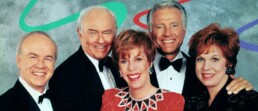
Carol Burnett, Vicki Lawrence, and Tim Conway laugh about the show's 11-year run (1967-78)
The ear tug, the Tarzan yell, the riotous spoof of Gone With the Wind, complete with the most awesomely ridiculous gown ever made from curtains and a rod. The Carol Burnett Show, which ran on CBS for 11 years and produced 278 episodes, is responsible for some of the funniest and most enduring TV moments of the 20th century. Few shows since have been able to duplicate Burnett’s comedic recipe: physical and broad, yet sly and sophisticated. And to think it almost didn’t happen. ”CBS did not want to put me on the air in a variety show because they said it’s a man’s game,” Burnett recalls. ”They said no woman has ever had a comedy variety show, but I had it in my contract that they had to give me one. They tried to talk me out of it — to do a sitcom. But I said variety is what I know and love — to do different characters every week.” The characters, be it Mama from the ”Family” sketches or Mr. Tudball and Mrs. Wiggins (”a person who the IQ fairy never visited,” quips Burnett), are indelible to both viewers and the cast. ”I have such fond memories of the show — not The Carol Burnett Show, other shows that I’ve done,” Tim Conway jokes. We asked three of the surviving members of the troupe, Burnett, Conway, and Vicki Lawrence (Harvey Korman passed away in 2008), to share some of their favorite behind-the-scenes stories.
Carol Burnett on the Gone With the Wind Spoof
When I got my own show, I thought, ”I want to do takeoffs of some of the movies I loved as a kid.” I remember [the sketch] had first been written that I would come downstairs with the draperies just hanging on me. I went to costume fittings and [the show’s costume designer] Bob Mackie said, ”I have an idea, come here,” and I went into the dressing room and there was the curtain rod with the draperies on it. And I fell to the floor. Of course, that was one of the longest — if not the longest — laughs we ever had on the show.
Tim Conway on His ”Old Man” Character
Carol gave us the opportunity to do whatever we wanted on the show, which was always great because we would surprise not only the audience but her, too. There were so many things we did on the air that were never done until we actually did them for taping. One was the Old Man. When we got the script that week, Harvey said, ”Wait a minute. He’s not doing an old man. I do the best old man there is.” So all week, Harvey is saying, ”What are you going to do as an old man?” and I said, ”I have no idea.” And I didn’t. I really didn’t do that shuffle with the Old Man until we were actually taping the show. When I started shuffling across the room, I noticed the rug was gathering in front of me and I thought, ”Jeez, if they let this go, we’re going to be here for three days.” But they let it go and it was created out of air.
Vicki Lawrence on the Creation of Mama
The writers who wrote the sketches hated their mothers. It was sort of like an homage to these horrible dysfunctional families they came from. They lovingly wrote Mama for Carol, and they had figured we’d have a guest star play Eunice. But when Carol saw the final draft of the sketch, Eunice just totally spoke to her upbringing. So she gave me Mama. She wanted to play Eunice — that pissed the writers off. She wanted to do it Southern — that pissed the writers off. They just figured we had ruined the whole thing. They said, ”You’re going to offend half the country.” And on the contrary, everybody loved it.
Today, all three comedians continue to perform for live audiences. Lawrence, 62, tours with her production Vicki Lawrence and Mama: A Two-Woman Show, where she tells autobiographical stories and then channels Mama to riff on current events. Conway, 77, is often on the road with his Tim Conway & Friends tour, reprising characters such as his diminutive golf instructor Dorf. Burnett, 78 — who appears in Laughter and Reflection With Carol Burnett, a free-flowing Q&A session with the audience — guest-starred on Glee last season as Sue Sylvester’s Nazi-hunting mother and is working on a book about her daughter, Carrie Hamilton, who passed away from cancer almost 10 years ago. (Tour dates are available on vickilawrence.com, timconway.com, and carolburnettfan.com.)
It’s hard to imagine that anything like The Carol Burnett Show will air on TV ever again. The cost would be prohibitive — the show employed a 28-piece orchestra, and designer Mackie led a team of seamstresses who were making 60 to 80 outfits per week. And to find a star with Burnett’s repertoire of considerable talents — comedian, singer, dancer, actor — seems impossible. To everybody except Conway, that is, who deadpans, ”Maybe the Kardashians.”